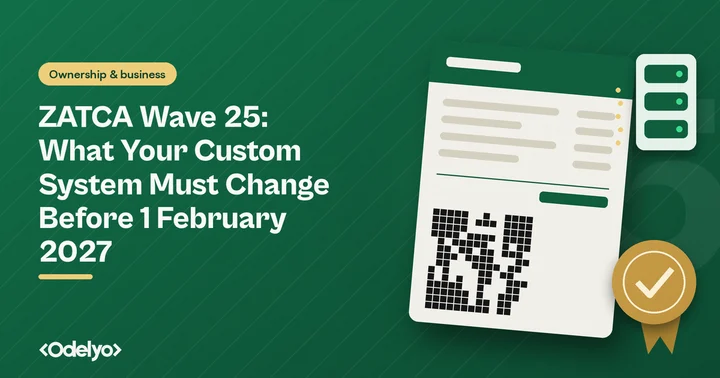
- Wave 25 covers businesses with VAT revenue above SAR 187,500 in any year from 2022 to 2025. Deadline: 1 February 2027.
- Phase two is an integration, not a template: signed XML, chained invoices, clearance for B2B, reporting within 24 hours for B2C.
- Custom stores, apps, and in-house ERPs need real development work. Start with a list of every place that issues invoices.
In July, ZATCA named the twenty-fifth group of businesses that must connect to the Fatoora platform. The bar is lower this time: VAT-subject revenue above SAR 187,500 in any year from 2022 to 2025. The deadline is 1 February 2027. That is a lot of small and mid-size companies that until now only had to print a QR code on their invoices.
Most of the guides you will find are written for people using off-the-shelf accounting software. Switch on a setting, update the app, done. This one is for the other group: businesses whose invoices are produced by something built for them. An online store with its own checkout. A booking app. A field-service system. An ERP someone customised years ago and nobody wants to touch.
Phase one and phase two are not the same job
Phase one asked you to generate invoices electronically, with a QR code. Phase two asks your system to talk to ZATCA. That is the real change. It is not a new PDF template; it is an integration, with keys, certificates, and error handling.
In practice, your system now has to:
- Produce each invoice as a structured XML file in the format ZATCA publishes (based on UBL 2.1), not only as a printable document.
- Sign it with a cryptographic stamp, using a certificate your system obtains from ZATCA during onboarding.
- Chain invoices together: every invoice carries the hash of the one before it, plus a counter that never skips or resets.
- Send standard tax invoices (business to business) for clearance before you share them with the buyer.
- Report simplified invoices (business to consumer) within 24 hours of issuing them.
- Show a richer QR code on simplified invoices.
Where custom systems usually break
When we look at an in-house system with phase two in mind, the same few problems come up. None of them are exotic. They are just things nobody needed before.
Invoices that get edited
Many custom systems let staff open an issued invoice and fix a typo. Under phase two, an issued invoice is final. Corrections go through credit and debit notes that point back to the original. If your admin panel has an “edit” button on issued invoices, that button has to go.
More than one place that issues invoices
The website issues some, the mobile app issues others, the branch POS issues a third set. Each device or unit that issues invoices needs its own onboarding and its own unbroken chain. Mapping them is the first real piece of work.
Checkout that cannot wait
Clearance is a live call to ZATCA. Your B2B flow needs a plan for when that call is slow or fails: retry, queue, and tell the user something sensible. A checkout that freezes because a tax server did not answer is a business problem, not a technical one.
Missing buyer data
B2B invoices need the buyer’s VAT number and address fields in a specific shape. If your sign-up form never asked for them, the data simply is not there.
A plan that fits in the time left
From today there are roughly eleven weeks until the deadline. That is enough if the work starts now and stays focused.
- Week one: inventory. List every place an invoice is created, who issues it, and whether the buyer is a business or a consumer.
- Weeks two to three: decide build or connect. You can build the integration into your own backend, or route invoices through a provider that already handles signing and submission. Both are valid; the right one depends on volume and how much of your system you want to change.
- Weeks three to seven: build and test in the sandbox. ZATCA provides a developer portal with a simulation environment. Test credit notes, failures, and offline cases, not only the happy path.
- Week eight: onboard production. Generate the production certificates for each issuing unit, from your own accounts.
- Weeks nine onward: watch it. Check rejected and warning responses daily for the first weeks. Most issues show up here, not in testing.
TipKeep the ZATCA certificates and the taxpayer portal under your company’s own accounts, not your developer’s. The same rule we give for app store and hosting accounts applies here.
Questions to put to whoever maintains your system
- Which parts of our system issue invoices today, and how many issuing units is that?
- Will you build the integration, or connect us to a provider? Why?
- What happens at checkout if ZATCA does not respond?
- How do we correct a wrong invoice after phase two?
- Who owns the certificates and keys, and where are they stored?
If the answers are vague, that tells you more than any checklist. ZATCA’s own e-invoicing pages are the reference; read the notification letter you receive carefully, because your exact date is in it.
Free toolSaudi VAT Calculator (15%)Add or remove 15% VAT from any amount and check invoice totals in seconds.Open the tool →Related reading
See a related case study: Dashierly. Our retail system, where sales, stock, and invoices live in one place. It shows how invoicing sits inside a wider product.
Service page: API development and integrations.
Not sure where your invoices actually come from?
Send us a short description of the system that issues them. We will tell you, in writing, what has to change for phase two and what can stay as it is. Send a brief · WhatsApp us. You get a first reply within one business day.