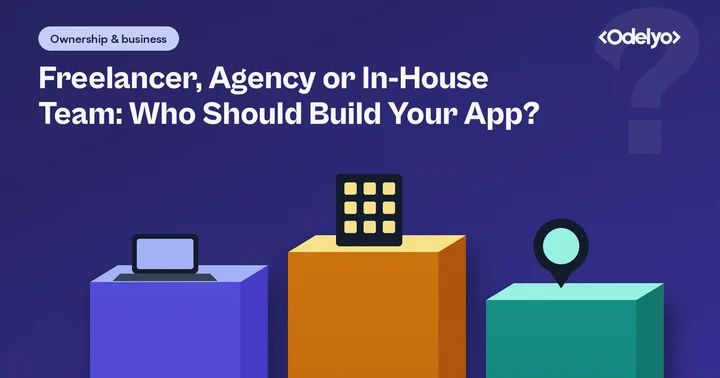
- A freelancer suits small, well-defined work; an agency suits a new product that needs design, mobile, backend and testing together; an in-house team suits a core product that changes for years.
- Whichever you pick, own the code and the store, domain and hosting accounts, pay by milestones you can test, and agree in writing who maintains the app after launch.
- A hybrid often works best: an agency builds version one, then hands over documented code and accounts to a small in-house team. Check current Nitaqat rules before planning hires.
We are an agency, so weigh what follows accordingly. We have still tried to write the version we would give a friend. The honest answer to “who should build my app?” depends on how big the product is, how long it will live, and whether you have someone on your side who can manage technical work. The table below is the short version. The sections after it explain where each option goes wrong.
The three options side by side
| Question | Freelancer | Agency | In-house team |
|---|---|---|---|
| How you pay | Per project or per hour, no overhead on top | Project fee or monthly retainer that includes management, design and QA time | Salaries, visas or social insurance, equipment, tools, and months of hiring before any code ships |
| Speed to start | Often fastest: one conversation and they begin | Days to weeks for scoping, then a team starts together | Slowest: recruiting, onboarding, building shared habits |
| If someone leaves or falls sick | The project stops | Someone else on the team picks it up | Depends on team size; a team of two has the same problem |
| Skills covered | Usually one or two: often app code, sometimes design or backend, rarely all plus testing | Design, mobile, backend, QA and project management in one place | Whatever you hired for, and you carry the gaps |
| Knowledge of your business | Shallow unless the engagement is long | Shallow at first, deeper over time | Deepest, and it stays with you |
| Best fit | Small, well-defined, short-lived work | A new product that needs several skills for a limited time | A core product that changes every week for years |
When a freelancer is the better choice
If the job is narrow and clear, a freelancer is often better value than an agency and we will say so. A landing page, a small internal tool, a fix to an existing app, a single integration, a prototype to test an idea: these do not need a project manager, a designer and a tester on the invoice. You also talk to the person who writes the code, which removes a layer of misunderstanding.
The risks are structural, not personal. One person is the whole team, so there is no second pair of eyes on the code and nobody to cover a holiday, an illness or a better offer. Design, backend, store submission and testing all depend on whether that individual happens to be good at them. Ask which parts they will do themselves and which they will hand to others, and who is accountable for the others.
When an agency is the better choice
An agency makes sense when the product needs several skills at once and you do not have anyone to coordinate them: a customer app, a provider app and an admin panel, for example, with design, backend, testing and store release. You pay for the coordination as well as the code, and that is the point. The work continues when one person is unavailable, and there is usually a process for review and release.
The downsides are real. Agencies cost more per hour of work than a freelancer, the senior person you met in the sales call may not be the one building, and a small client can end up at the back of a busy queue. Ask who exactly will work on your project, how many of your size they handle at once, and what happens if the lead developer leaves.
When an in-house team is the better choice
If the app is the business, or changes every week, you will eventually want your own people. They learn your customers, sit in the same meetings, and can answer a request the same day. The trade-off is that you become the employer: recruiting, management, replacing leavers, and keeping the team busy and growing. A single in-house developer is not a team. They cannot be their own designer, tester and backup.
In Saudi Arabia, in-house hiring has another layer. Saudization targets under the Nitaqat programme, run by the Ministry of Human Resources and Social Development, depend on your activity and company size, and they change over time. Hiring developers affects your headcount and your Saudi share, which can be a strength or a constraint depending on where you stand. Check the current rules for your sector with the ministry or your HR adviser before you plan a team around them.
Contracts, code and accounts: the same rules for all three
Whoever you choose, put these in writing. The contract should name you as owner of the source code and designs on payment. The repositories, the Apple Developer and Google Play accounts, the domain, the hosting and the cloud services should be registered in your company name, with the builder added as a user, never the other way around. Payments should follow milestones you can see and test, not dates. We wrote a longer piece on this in how to keep ownership of your software, and our free quote and contract generator gives you the clauses to start from.
Communication and time zones
Working with someone in your own time zone and language is a real advantage, particularly for Arabic-first products where wording and right-to-left layout need a native eye. A remote freelancer or an overseas agency can still work well if you agree on a shared weekly slot, one channel for decisions, and a demo at the end of each milestone. Without that, the distance is not the problem. The silence is.
After launch: who looks after it?
This is where most arrangements quietly fail. Apps need regular updates for new phone versions, store rules and security patches, and someone has to be responsible when something breaks on a Friday. Before you sign, ask who does this, whether it is included or a separate agreement, and how fast they reply. Our piece on what to expect after your app launches has a list of questions to bring.
Free toolQuote & Contract GeneratorBuild a clear quote and contract with scope, milestones, and ownership terms.Open the tool →Red flags, by option
- Freelancer: no portfolio you can open on a real phone, refuses to put the code in your repository, wants everything paid upfront, promises to do design, backend, iOS, Android and testing alone in an unrealistic time, or disappears for days without notice.
- Agency: will not say who will work on your project, will not give you the source code or accounts on delivery, quotes a fixed price without asking a single question about your users, or treats support as an afterthought.
- In-house: hiring one developer and expecting a product team, no senior person to review their work, no plan for when they leave, and a backlog nobody prioritises.
The hybrid that works more often than people expect
Many Gulf companies do best with a sequence. An agency or a strong freelancer builds the first version, because it needs several skills for a few months. Once the product has users and a stable shape, you hire a small in-house team and the builder hands over: documented code, accounts transferred, a walkthrough of the architecture and a short period of paired support. The earlier you plan this, the cheaper it is. Insist on handover documents from day one, not as a last-week request. The other common hybrid is the reverse: an in-house product owner who decides what to build, plus an external team that builds it.
We took over exactly this kind of project with Ru’ya, which came to us as a live app with a broken calling system. We redesigned it, fixed the calls and rebuilt the backend. Taking over someone else’s product is where clear handover documents and account access pay off, and where their absence costs the most.
A quick way to decide
- Is the work small and clearly defined? Start with a freelancer.
- Does it need design, mobile, backend and testing together, and nobody on your side to coordinate? Look at an agency.
- Will the product change weekly for years, and are you ready to manage people? Plan for an in-house team, possibly after an agency builds version one.
- Whatever you choose: own the code and accounts, pay by milestone, and agree who maintains the app after launch.
Related reading
See a related case study: Ru’ya. A client arrived with a live app and a broken calling system. We redesigned it, fixed the calls, rebuilt the backend and added the tools the team needed to run it. A good example of what taking over someone else’s product involves.
Service page: Flutter app development.
Not sure which setup fits your project?
Tell us what you are building and who will run it after launch. We will say honestly whether you need us, a good freelancer, or your own hire, and what to ask whoever you pick. Send a brief · WhatsApp us. You get a first reply within one business day.