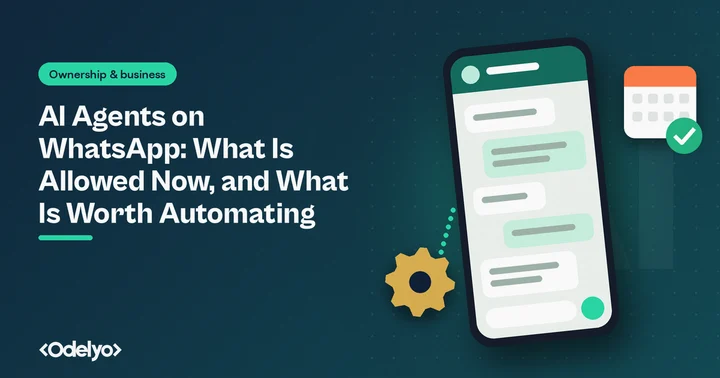
- Since 15 January 2026 WhatsApp bars general-purpose AI assistants, not businesses using AI to serve their own customers.
- Automate what a new hire could learn from one page of notes: hours, bookings, order status. Keep complaints and quotes human.
- The value is in the connection to your calendar, orders, and CRM. Without it, the agent is just a nicer FAQ.
It is 11 at night and a customer asks on WhatsApp whether you have a slot on Saturday. Nobody answers until 9 the next morning. By then they have booked somewhere else. That small, ordinary loss is the real reason so many businesses are looking at AI agents on WhatsApp this year, not the hype around them.
At the same time, many owners have heard that WhatsApp “banned AI”. That is not quite what happened, and the difference matters if you are about to spend money on this.
What WhatsApp actually changed
Since 15 January 2026, Meta’s terms for the WhatsApp Business Solution stop AI companies from offering general-purpose assistants through it, the ChatGPT-style bot whose whole product is “ask me anything”. What stays allowed is a business using AI to serve its own customers: answering questions about its services, taking bookings, tracking orders, handling support.
So the rule pushes in a useful direction. An agent on your number should do your business’s jobs, and hand over to a person when it cannot. Before you build anything, read the current WhatsApp Business policy; Meta has adjusted it more than once.
Good jobs for an agent, and bad ones
A simple test: if a new employee could learn the answer from one page of notes, an agent can probably do it. If the answer depends on judgement, a relationship, or a negotiation, it probably cannot.
Usually worth automating:
- Opening hours, locations, prices you already publish, and what each service includes.
- Booking, rescheduling, and cancelling appointments.
- “Where is my order?” and delivery questions.
- Collecting the details your team needs before they call back: name, city, what the customer wants.
- Reminders and confirmations the customer asked for.
Usually better left to a person:
- Complaints and refunds. An upset customer wants to feel heard by someone.
- Custom quotes and negotiations.
- Anything medical, legal, or financial where a wrong answer has real consequences.
The bot is the easy part
An agent that only talks is a nicer FAQ page. The value appears when it can do things, and that means it has to be connected to the systems where the work lives: your booking calendar, your order database, your CRM, your stock. “Your appointment is confirmed for Saturday at 4” is only true if the agent actually wrote it into the calendar your staff use.
This is where most of the effort goes, and where most cheap setups fall short. Before choosing a platform, list the systems the agent must read from and write to. If any of them has no API, that is the first problem to solve.
TipAlways give the customer a clear way to reach a human, in the same chat. It is good practice, and it is what WhatsApp expects from automated business conversations.
Customer data is your responsibility
Everything customers type into WhatsApp is personal data, and in Saudi Arabia it falls under the Personal Data Protection Law. A few practical questions to settle early: where are the conversations stored, and for how long? Which AI provider processes the messages, and in which country? Who on your team can read the history? A good setup answers these in writing before launch, not after a customer asks.
Free toolAI Agent Savings CalculatorEnter how many messages your team handles and see the hours an agent could take off their week.Open the tool →Start with one flow
The projects that work start narrow. Pick the single question your team answers most often, or the one booking flow that loses customers after hours. Build the agent for that, connect it properly, and watch the real conversations for a few weeks. You will learn more from that than from any demo, and you will know exactly what the second flow should be.
Related reading
See a related case study: ROYA OPS. Our AI marketing operations system. It shows how AI work is split into small, checked tasks instead of one open-ended bot.
Service page: AI agents and automation.
Thinking about an agent for your WhatsApp?
Send us the questions your team answers every day. We will tell you which ones are worth automating, what the agent needs to connect to, and what should stay with a person. Send a brief · WhatsApp us. You get a first reply within one business day.