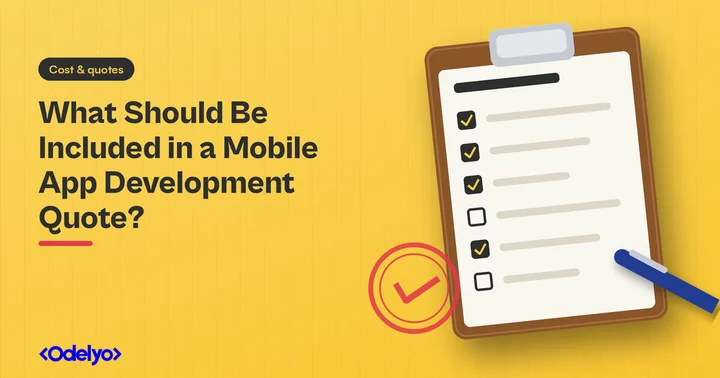
- A good quote lists scope, platforms, design, backend, admin, integrations, testing, and publishing.
- It also states milestones, payment terms, warranty, and exactly what you receive at handover.
- Vague lines such as “booking feature” are a red flag: ask for testable scope sentences.
When you collect quotes for a mobile app, they often look impossible to compare. One is a single line, another is twelve pages. The difference is rarely the price; it is what each one leaves out. Use this checklist to read any quote, ours included.
1. A written scope
The scope lists what is being built, screen by screen or feature by feature. Look for it in plain words, not just “mobile app with standard features”. If it is not written, it is not in the quote.
- User roles (customer, provider, admin)
- Main flows (sign-up, browse, book, pay, chat)
- What is explicitly out of scope
2. Platforms
State whether the app targets iOS, Android, or both, and how. With a cross-platform framework such as Flutter, one codebase covers both. With native apps, it is two builds. The quote should say which.
3. Design
Does the quote include UX and UI design, or do you bring finished designs? Does it include revisions, and how many rounds? Is Arabic right-to-left design included if you need it?
4. The backend
The app is the visible half. The quote should name the API, database, file storage, and authentication, and say whether it uses a managed service or a custom server. If a quote says nothing about the backend, ask.
5. The admin dashboard
Who manages users, orders, content, and reports? A real app almost always needs an admin side. Check whether it is included, and what it can do.
6. Integrations
List every external service: payment gateways, maps, SMS, email, push notifications, calls, analytics, and any existing system. Each one should appear by name.
7. Testing and quality
What is tested, on which devices, and by whom? A quote should mention testing on real devices and a way for you to try builds before launch.
8. Store accounts and publishing
Who creates the Apple and Google developer accounts, and in whose name? They should be in your name. The quote should cover preparing store listings, screenshots, privacy policy requirements, and handling the review process.
9. Timeline and milestones
A timeline with clear milestones lets you see progress. Ask what you review at each stage, and what you need to provide: content, logos, accounts, approvals. Delays often come from missing inputs, not from code.
10. Payment terms
Payment tied to milestones protects both sides. At Odelyo, it is three parts: to start, after design approval, and before launch. Be wary of large payments with nothing to show.
11. Warranty and support
What if something breaks after launch? Ask what is covered, for how long, and how to report issues. Our standard is a 30-day bug-fix warranty after launch. Ongoing maintenance, new features, and hosting are separate, so ask how they are handled.
12. Ownership and handover
You should own the source code and receive a handover: repository access, documentation, credentials, and a walkthrough. If a quote does not mention ownership, ask in writing before signing.
Free toolQuote & Contract GeneratorBuild a clear quote and contract with scope, milestones, and ownership terms.Open the tool →Red flags
- A single line with no scope.
- “Unlimited revisions” or “everything included” with no definitions.
- No mention of backend, admin, or store accounts.
- Developer accounts opened in the agency’s name.
- No clear statement about who owns the code.
- Pressure to pay everything upfront.
A simple way to compare
Put quotes side by side in a table with rows for each item above. Mark each cell: included, excluded, or not mentioned. The “not mentioned” cells are where surprises hide. Ask each developer to fill them in before you decide.
How we quote
We ask for a short brief, send back questions, and then send a written scope with a fixed quote. Payment is in three milestones, accounts are in your name, you get the source code and handover, and the first 30 days after launch include bug fixes.
Questions to ask before you accept
- If I change my mind about a feature halfway, how is that handled and quoted?
- What do you need from me, and by when, so the timeline holds?
- Can I test builds before launch, and on which devices?
- How do I report a bug after launch, and how fast will I get a reply?
- What exactly do I receive on the final day?
A developer who answers these clearly, in writing, is usually one who has thought about the project properly.
An example of scope wording
Instead of “booking feature”, a clear line reads: “A customer selects a service and time slot, pays through the payment gateway, receives a confirmation by email and push notification, and can cancel until 24 hours before; the admin can see and edit all bookings.” That sentence can be built, tested, and checked. The vague version cannot.
Ask for the quote in a format you can compare
Request the same structure from every developer: scope, platforms, design, backend, admin, integrations, testing, publishing, timeline, payment terms, warranty, and ownership. When every quote answers the same twelve headings, the real differences become visible, and the decision becomes much easier.
Related reading
See a related case study: Divercity Rental. A mobile marketplace for golf-cart rentals, with maps, booking, and owner listings: a good example of an app plus the backend and admin behind it.
Service page: Flutter app development.
Already have a quote and want a second opinion?
Send it with your brief and we will tell you what looks missing. Send a brief · WhatsApp us. You get a first reply within one business day.