- For most business apps, Flutter delivers iOS and Android from one codebase with native-level quality.
- Native wins when the app depends on heavy device features or platform-specific tech.
- Test the riskiest feature early with a small proof of concept before committing.
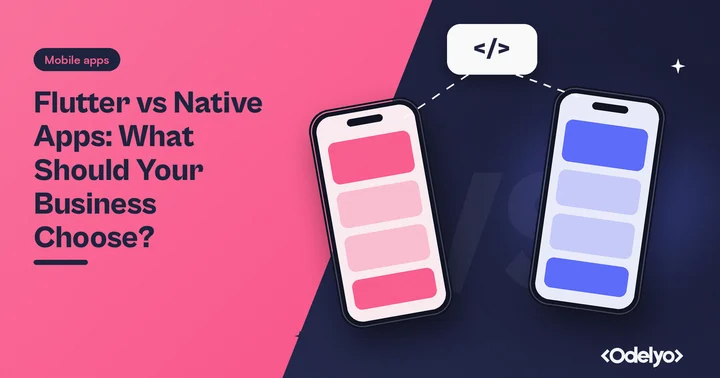
“Should we build native or Flutter?” sounds like a technical question, but it is really a business one: how many products do you want to maintain, how fast do you need to launch, and what does your app need from the phone? Here is a plain comparison.
The two options, in one paragraph each
Native means building a separate app for each platform: Swift or SwiftUI for iOS, Kotlin for Android. Each app uses the platform tools directly.
Flutter is a framework from Google that builds iOS and Android apps from a single codebase written in Dart. The screens look and behave the same on both, and the app can still reach camera, location, notifications, payments, and other phone features through plugins.
Why many business apps choose Flutter
- One codebase, two platforms. You pay for one app, and new features arrive on iOS and Android together.
- Easier to keep consistent. One design, one set of rules, one place to fix a bug.
- Good fit for Arabic and multilingual apps. Right-to-left layouts and several languages are well supported when planned from the start.
- Fast iteration. Changes can be tried quickly during development, which helps when requirements are still forming.
- Simpler team. One codebase means one team to brief, instead of two to coordinate.
When native is the better choice
- The app depends heavily on newest platform features the day they are released.
- It needs deep hardware integration: advanced camera pipelines, Bluetooth accessories, specialised sensors, or background processing with strict system rules.
- It is a graphics-intensive app such as a 3D game or a complex AR experience.
- You already have separate iOS and Android teams with an existing native codebase.
- Only one platform matters for your audience, and you want to use its conventions fully.
| Flutter | Native | |
|---|---|---|
| Codebases | One for iOS and Android | One per platform |
| Feature parity | Same features ship together | Can drift between platforms |
| Device-heavy features | Possible through plugins | Most direct access |
| Best for | Most business and SaaS apps | Hardware-heavy or platform-specific apps |
A decision checklist
- Do we need both iOS and Android? If yes, Flutter saves effort.
- Is our app mostly forms, lists, maps, bookings, chat, payments, and dashboards? Flutter handles these well.
- Do we depend on a special device feature? Ask your developer to confirm a plugin exists, or whether custom platform code is needed.
- Is time to market important? One codebase usually means fewer moving parts.
- Who will maintain the app in two years? A single codebase is easier to hand over and to continue.
- Do we have an existing native app? Rewriting is a business decision of its own; do not switch just for fashion.
Practical examples
A booking marketplace. Maps, listings, calendars, payments, notifications, and an owner side: a typical Flutter project, with a backend and an admin panel behind it.
A learning platform. Lessons, schedules, video or voice, and three languages. Flutter fits well, as long as the call feature is tested on real devices.
A specialised hardware app. If the app connects to a custom Bluetooth device with strict timing, discuss native components early, even inside a Flutter app.
Myths to ignore
- “Flutter apps are not real apps.” They are installed from the same stores and run as normal apps.
- “Native is always faster.” For typical business apps, users will not feel a difference; the backend and design matter more.
- “Cross-platform means lower quality.” Quality comes from planning, testing on real devices, and care, not from the number of codebases.
What is the same either way
Whichever route you pick, you still need a backend, an admin side, store accounts, testing, and a launch plan. The cost drivers are mostly the same: screens, flows, integrations, languages, and design. The choice of Flutter or native changes how many apps you build, not whether you need the rest.
Ownership matters more than the framework
Whatever you choose, insist on owning the source code, having the store accounts in your name, and receiving a handover. A well-documented Flutter project can be continued by another developer, and so can a native one, if you have the code and the documentation.
Free toolApp or Website? quizSix questions that tell you whether you need an app, a website, or both.Open the tool →Our usual advice
For most business apps we recommend Flutter, and we say so when native is the better fit. The brief tells us which. We build Flutter apps with a written scope and a fixed quote, three payment milestones, and a 30-day bug-fix warranty after launch.
How to test the decision before committing
If you are unsure, ask for a short technical review of the riskiest feature. For example, if your app needs a special payment method or a background task, confirm early that it works on both platforms. A small proof of concept, done before the full build, is far cheaper than discovering a limitation in month three.
Questions for your developer
- Which features of my app depend on platform-specific code, if any?
- How will you test on real iOS and Android devices?
- How will the project be documented, so someone else can continue it?
- Who creates the store accounts, and in whose name?
Cost and timeline, without numbers
We do not publish prices, and the framework alone never decides one. What a quote reflects is the number of screens, flows, integrations, and languages. Choosing Flutter usually removes the duplication of building the same features twice, which is why it is often the efficient route for an app that must exist on both platforms. A written scope shows you exactly where the effort goes.
Related reading
See a related case study: Ghras. A learning and tutoring platform in Arabic, English, and French: a good example of a multilingual mobile product built for two platforms.
Service page: Flutter app development.
Trying to choose between Flutter and native for a specific idea?
Tell us what the app needs to do on the phone. Send a brief · WhatsApp us. You get a first reply within one business day.