- Match the model to the business: stamps for cafés, points or cashback for retail, tiers only when customers spend a lot over time.
- Loyalty apps die from download friction, rewards that are too far away and no reason to open them. Try a Wallet pass, web app, WhatsApp or POS phone-number loyalty first.
- Version one: sign-up by phone and OTP, earning at the counter, visible progress, a birthday reward, sparing push. Get marketing consent separately (PDPL) and track repeat visits and redemptions.
Ask a café owner in Riyadh, Jeddah or Khobar what they want from a loyalty app and the answer is almost always the same: “I want people to come back.” Fair. But a loyalty app does not create a reason to come back. The coffee, the seating, the speed and the staff do. What the app does is make the return visit slightly more rewarding and slightly easier to repeat, and give you a way to say hello without paying for an ad.
Treat it that way and the design decisions get much simpler.
Start with the reward model, not the app
There are four common models. Each suits a different kind of business, and the mistake we see most is copying the one a big chain uses.
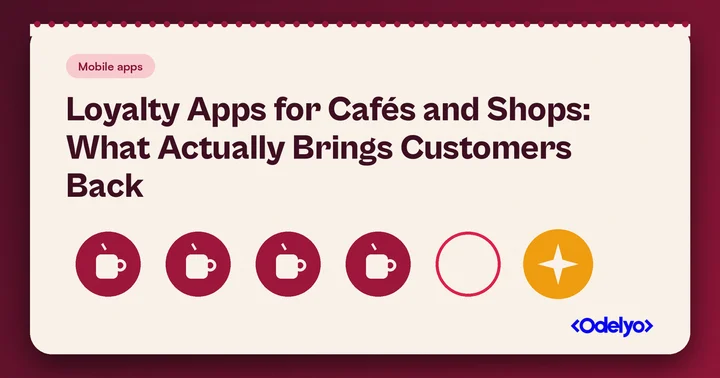
- Stamp card (buy nine, get the tenth free). The best fit for a café or bakery. Purchases are frequent, small and similar in value, and anyone understands it in two seconds. Its weakness: it only rewards one product.
- Points (so many points per riyal, redeemed against a catalogue). Fits a shop where baskets vary a lot, such as fashion, perfumes, a grocery or a pharmacy. It needs a reward the customer actually wants and a balance they can read.
- Tiers (silver, gold, and so on). Only worth it when customers spend large amounts over time. For a café, tiers are usually decoration; nobody needs a status level for a flat white.
- Cashback (a percentage returned as credit). The simplest to explain and good for retail, but it shrinks your margin on every sale, including the sales that would have happened anyway. Be careful with it on thin-margin items.
A simple rule: the lower the ticket and the higher the visit frequency, the simpler the model should be. A café should almost always start with stamps.
Why so many loyalty apps die
Most loyalty apps are installed once and opened never. Three causes explain nearly all of it.
1. Download friction. To get the first stamp, the customer must find the app in the store, download it, wait, sign up and verify a number, while the barista waits and a queue builds. Many people give up at that step, and you rarely get a second chance.
2. The reward is too far away. If the first free coffee needs ten visits and the customer drinks coffee at your place twice a month, that is five months. Early progress has to be quick: a welcome stamp on sign-up, or a reward after the third visit, not the tenth.
3. No reason to open the app. If the app only holds a number, the customer opens it at the till at best. Something has to pull them in between visits: a visible progress bar, a birthday gift, a seasonal item, an expiring reward. And the pull has to be earned. Daily push notifications train people to switch them off.
TipA loyalty app that only works when a cashier remembers to ask about it is not a loyalty app. It is a delay at the counter.
Try something lighter first
You do not need to begin with an app in the stores. Four lighter options are worth testing, and some of them may be all you ever need.
- Apple Wallet and Google Wallet passes. The customer adds a card to the phone wallet from a link or QR code, with nothing to download. Apple supports loyalty and membership passes that update dynamically and can notify holders, and Google has its own loyalty card passes. Tap-to-redeem at a terminal is a separate, heavier step that needs NFC certification and compatible hardware, so start with a QR scan.
- A web app (PWA). A page opened from a QR code, saved to the home screen. No store review, one codebase, and you can ship changes the same day. It cannot do everything a native app can, but a stamp card needs very little.
- WhatsApp. Many customers already live there, so a “message us to join” flow with a stamp count in reply is a low-friction start. It works for reminders and offers once the customer has agreed to receive them, but it is a messaging channel, not a loyalty ledger, so do not run the balances in chat threads by hand.
- POS-linked phone-number loyalty. The cashier types or scans the customer’s mobile number at the till, and the point-of-sale system records the visit and the points. Nothing to install at all. If your POS can hold customers and sales history, this may be the strongest option for a shop. It is also how owning the customer relationship starts, because the phone number is what the delivery apps do not hand over.
A common route: phone-number loyalty at the counter first, then a Wallet pass or web app so customers can see their progress, then a native app only when you have proof that people use the first two.
What a good version one needs
- Sign-up by mobile number and a one-time code. No long forms, no passwords. Name and birthday are optional extras, asked for after the first reward.
- Earning at the counter in a few seconds. A QR code the customer shows (or the cashier scans), or a link to your POS so every sale credits the right customer automatically. If it takes longer than paying, staff will skip it.
- Visible progress. “Two more visits to your free drink” beats any balance in points.
- A first reward that is close. Give a welcome stamp or a small gift at sign-up.
- A birthday reward. One of the few messages customers are happy to receive, and cheap to run.
- Push used sparingly. A few messages a month at most, each with a clear reason: a reward is close, a reward is expiring, a new item is out.
- A staff view. The cashier must be able to see the customer, add or cancel a stamp, and handle a mistake without calling the owner.
Leave tiers, referral games, a points shop and in-app ordering for later. Each one adds work and each one can be copied once the habit exists.
Data and consent: the PDPL basics
A loyalty programme is a list of people’s phone numbers, visit history and possibly birthdays. That is personal data under Saudi Arabia’s Personal Data Protection Law, which has been fully enforceable since 14 September 2024, with SDAIA as the regulator (CMS summary). We are not lawyers, so check specifics with one, but the working rules are straightforward:
- Say plainly what you collect and why, at sign-up, in Arabic as well as English.
- Ask for consent to marketing messages separately from joining the programme. Under the implementing regulation, marketing messages need the recipient’s prior consent, and you must stop immediately if they withdraw it.
- Collect only what you use. If you never use the birthday year, do not ask for it.
- Make it easy to see, correct and delete their data, and keep access to the customer list limited to the people who need it.
Our PDPL checklist for apps and websites goes through this in more detail.
Free toolApp Scope PlannerList your features and see which belong in version one, and which can wait.Open the tool →How to know whether it works
Skip vanity figures like downloads. Three numbers are enough:
- Repeat visit rate: of the customers who joined in a given month, what share came back within 30 and 60 days?
- Redemption rate: what share of earned rewards are actually claimed? Very low means the reward is not attractive or not reachable; very high may mean the reward costs more than it brings.
- Share of sales from members: how many of your daily transactions are identified to a member. If staff are not asking, this number tells you in a week.
Compare members with a similar group of non-members over the same weeks, and watch the cost of rewards against the extra visits. Do this before adding features.
If you want a second opinion on what belongs in your first version, send us the idea and we will mark what to build now and what to leave out.
Related reading
See a related case study: Dashierly. A retail POS and operating system with a customers module. A useful reference for the idea that loyalty works best when it sits next to the till rather than beside it.
Service page: Mobile app development.
Planning a loyalty programme for your café or shop?
Tell us how you take payment today and how many branches you run. We will suggest whether a Wallet pass, a phone-number scheme or a small app is the right first step, and what version one should leave out. Send a brief · WhatsApp us. You get a first reply within one business day.